
Pro TIPs
Real yields are the real deal and you really should keep an eye on them

So, this piece was at least partially prompted by Bob Elliott, who does consistently good work and has (rather annoyingly) lost a bunch of weight. Let’s assume Mr. Elliott doesn’t mind me referring to him as Bob. Bob put out this tweet, and Marketwatch followed up with this piece. I wanted to discuss Bob’s point. First of all, I agree TIPs are cheap, and I suspect they are a good long-term investment at 3% real yields.
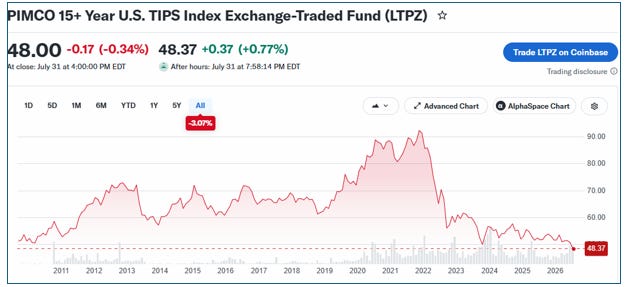
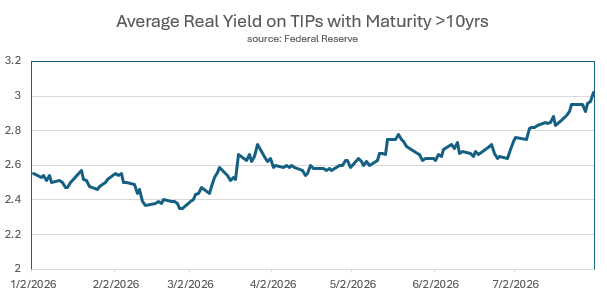
However, what I am more interested in is WHY they are so cheap. I know I shouldn’t look gift horses in the mouth, but I am a very cynical person. I like to understand why markets are being so generous as to offer little old me “a generational buying opportunity”.
Part of my reticence is that I am already long of $200k of 30year TIPs, which I bought at 2.75%, thinking that cheap, and a “good long-term investment”. And that 25bps is not exactly inconsequential. I am down about 18% on my purchases because long TIPs have big durations. So why am I getting another “generational buying opportunity”, and will I have an even better buying opportunity in a year’s time? At the risk of ruining the piece by mistiming the punchline, I think the answer to the first question is the combination of deteriorating availability of global capital, coupled with the AI buildout/bubble conditions in the US. The answer to the second question is while this situation persists, real yields will remain elevated and TIPs yields remain stubbornly high if not higher. Let me explain.
Why should you care about TIPs?
Well, the first best answer is you shouldn’t. They are about 5% of the US fixed income universe, and they are incredibly illiquid. Trading costs are much higher, and for big asset managers it’s pretty expensive to trade in and out. Desks have limited ability to get in and out of positions (outside of auctions), and big durations and the need to front liquidity to clients means marginal desks with marginal flows are on a hiding to nothing. A horrible market to trade.
However, TIPs have two massive advantages for investors. First, they allow bond investors to take positions in real yields and avoid CPI exposure. TIPs can reduce your exposure to inflation. As someone already flirting with retirement, solving the problem of transferring present consumption reliably into the future is very important to me. Ideally, I would like to be able to swap current consumption for future consumption in a way which a) gives me some “vig” for foregoing present consumption, but also b) reliably returns my principle. Since TIPs are US government instruments issued in US dollars I should be able to plan to receive par x (the change in the CPI) dollars with will have roughly the same buying power with close to absolute certainty. I don’t even need to invoke the law of large numbers. Lets call this “the retirement problem” cos that’s the problem that I and every person who wants to retire needs to solve.
I am so old, I can remember when this was considered a pretty tricky problem. People were living longer, and real yields were very low. At various points in the 00s, the market refused to pay you for foregoing consumption today, and future consumption traded at a premium to spot. To put it in more prosaic terms, long real yields were negative. Back then, pension funds liabilities often exceeded their assets. They were technically bust, but out of good manners, no one made a fuss about it. We all just assumed “something would come up” as my wife often says. She’s a very optimistic person.
But something did! Equities (particularly US equities) have done shockingly well, and bond yields are now much higher. This means that pension funds are no longer insolvent. Hurray! We might not have to pretend to own cats when buying cat food after all!
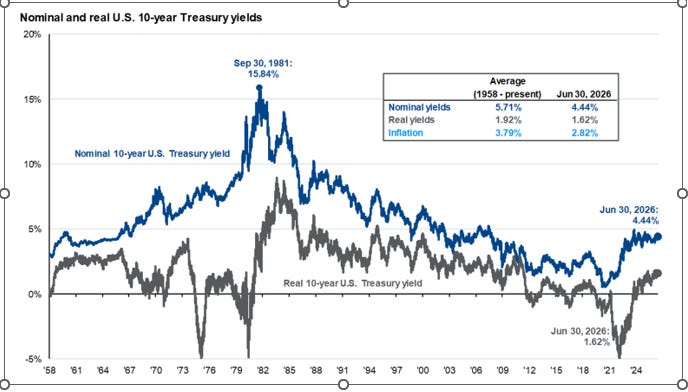
Which is why I don’t understand why US pension funds aren’t buying long TIPs hand over fist right now. Pension fund managers could sell some equities, buy long TIPs and lock in a 3% real return for their investors. Since US real GDP growth is of the order of 3% over the last few hundred years, that seems pretty much par.
Period Annualized real GDP growth
1947–2025 3.11%
1980–2025 2.68%
2000–2025 2.13%
1995–2025 2.49%
I mean you might do better in the medium term, but to do so you would need atypically high levels of profit growth. Usually that only happens when total factor productivity growth is unusually high. Particularly if you limit future immigration and therefore population growth. I can see why AI might do precisely that but its the future, and the future is inherently uncertain.
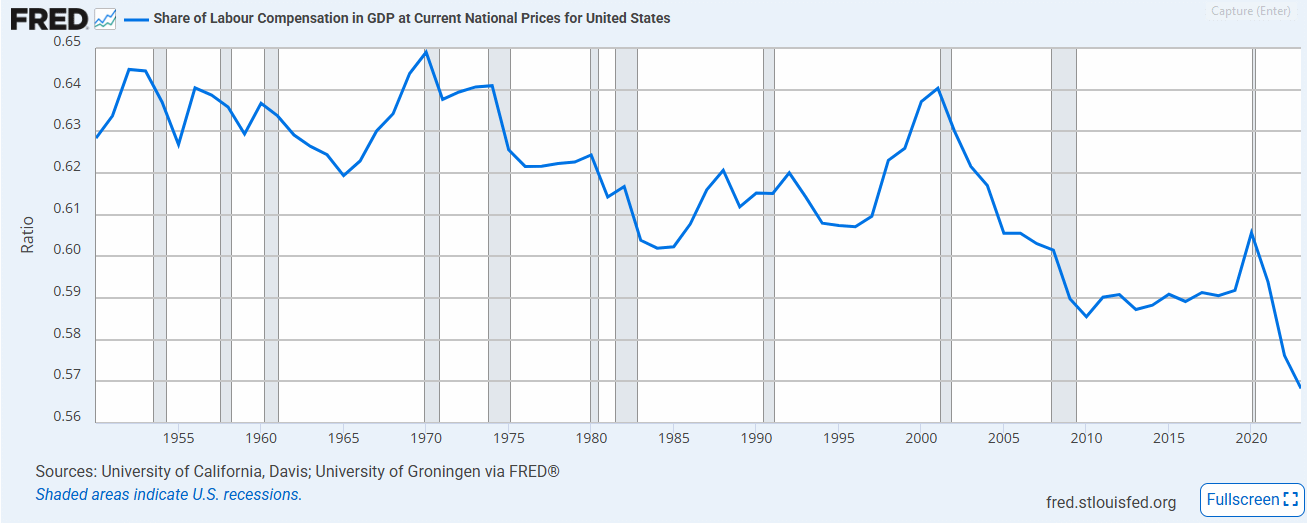
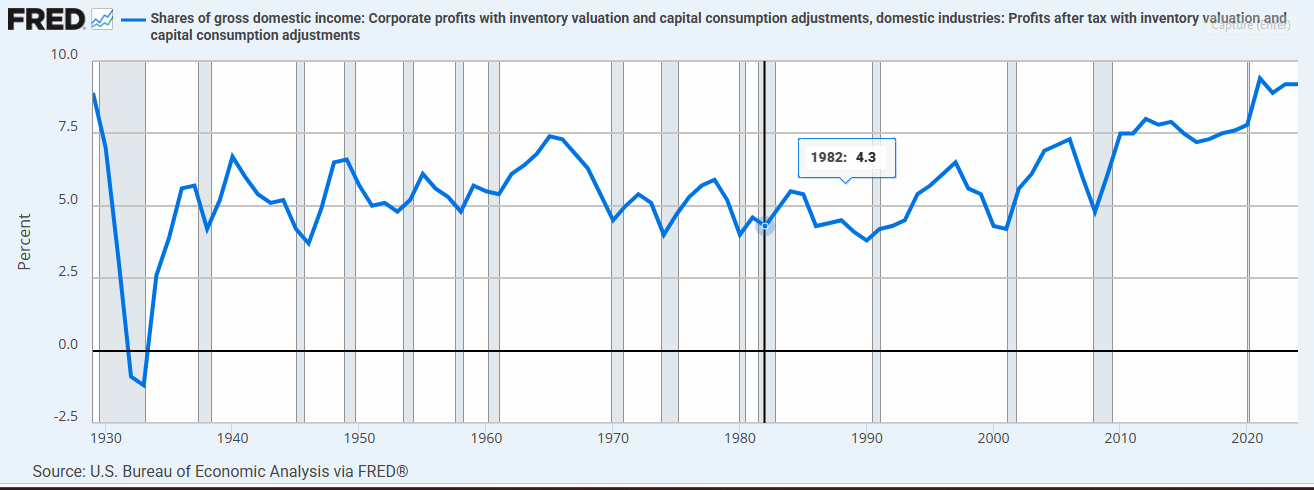
There is another way in which returns in the stock market might outpace 3% real returns over an extended period. The labor share of GDP could continue to fall, while the profit share of GDP could continue to rise. This is also entirely consistent with the AI story and is pretty much the argument I hear among AI buildout optimists, although they don’t express it this way. The labor share of GDP hit a new low of 56.8% back in 2023.
The profit share hit a new high of 9.2% in 2024, which by some strange coincidence, is pretty close to the 8.9% profit share in 1929.
I run through all this cos I want to show how in the long run, TIPs should be a very good way of limiting exposure to high and increasing levels of public sector indebtedness which will increasingly be difficult to sustain without far higher levels of unanticipated inflation.
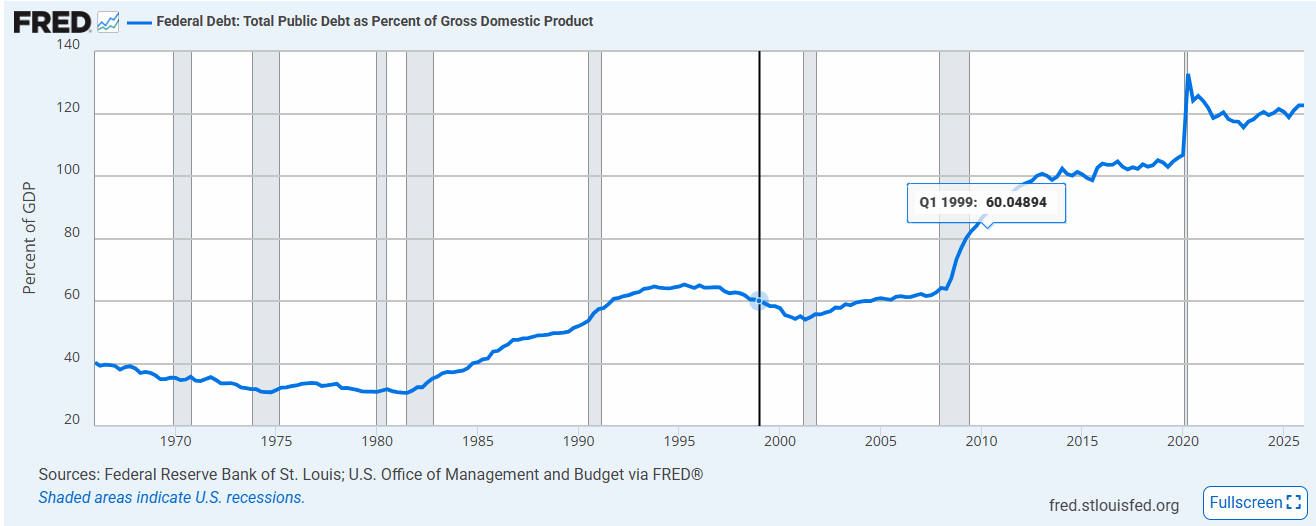
Higher levels of unanticipated inflation will erode away the debt, which is a feature for the debtor, but a bug for the creditor. But owning TIPs or equities mitigates much of the damage. Naturally government will have an incentive to suppress published inflation, and we all know how effective the right incentives can be! So maybe the average CPI index will not fully compensate you. It’s also worth noting that our personal CPI basket might diverge quite a way from the average CPI basket (mine has a much higher weight for chocolate). But under almost all reasonable scenarios TIPs will deliver an unspectacular but entirely reliable retirement for investors.
Except nobody cares.
So why are North American pension funds NOT buying TIPs hand over fist right now? Why is the dog not barking?
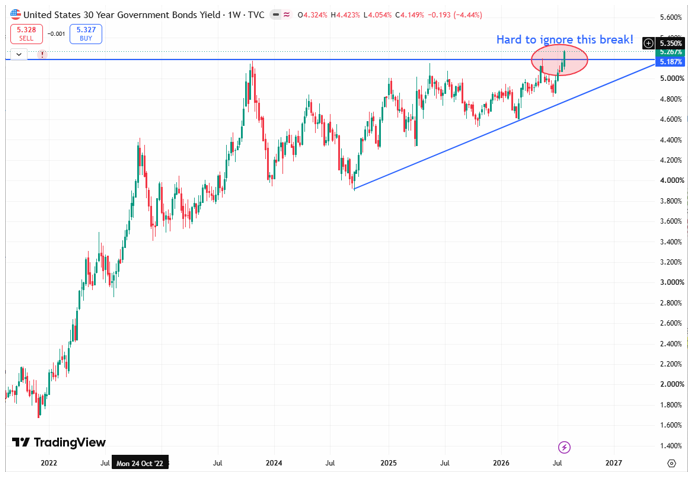
Well one possible answer might be that they believe productivity growth will continue to grow at exceptionally high rates for the foreseeable future. In which case equities will do very well and much better than 3% real. Another might be that they think that AI will force the profit share of GDP still higher over time (same). Another might be that they can see the risk of longer-term inflation and that they don’t trust the CPI to fully capture inflation (you don’t get the 3% real but less). They might think TIPs will get cheaper because the US government is producing a LOT of debt and an unsustainable amount of that debt is issued at the short end (you do get the 3% real, but if you wait you will get 3.5%). None of these arguments are exclusive. You could think that all of the above are currently in play, although the latter is an overshooting argument and if true would suggest a sudden snap back is a possibility.
It’s also worth noting that the TIPs is very small and very illiquid. Pension funds couldn’t possibly do any size at current yields without moving the market against themselves. So, maybe they think there is no point trying?
I give all of these possibilities some credence, except for the last because I really don’t think markets leave pennies on the ground, even if said pennies won’t move the dial. But the thought I can’t shake is that the unattractiveness of TIPs is itself an index of the strength of the current bubble psychology. The TIPs market was specifically created to mirror pension funds liabilities: am asset class specifically created to directly address investor needs. And the very investors who might look at it and say, “thanks very much!” are instead saying “only fools would buy 30-year real yields at 3%. Yeah, probably!
If the past is any guide to the future, pension funds will one day look back wistfully at 3% real yields but only when they lose faith in equities. And that won’t happen until equities start falling. Right now that doesn’t seem to be imminent. That said, watching recent events in Korea, maybe it’s not that far away either.
From JPM AM’s Guide to Markets
I think there are problems with the CPI basket representing actual cost of living - eg healthcare underreported and housing OER has lagged prices for a long time. Gold has outpaced nominal growth and has the China bid so seems like a better long term way to preserve purchasing power
Perhaps the change will come when the populist uprising is completed as the corporate share of profits will then be clawed back and equities decline with that outcome. But when that happens, I want to be in a remote area with food and fuel to live completely off the grid, cause its gonna get messy in the cities