
Sharing the burden

My apologies. This post has been somewhat delayed by the World Cup.
Many years ago I studied economics at an old British college that benefited enormously from Henry VIII's desire to remarry. This was a mistake (on my part, not Henry Tudor’s) because everyone thinks they understand economics, regardless of whether they wasted time studying it. We might all be better off if no one studied economics but focused instead on plumbing, or masonry, or even analytic philosophy. I cut my losses after 4-5 years of study but foolishly compounded the error by taking a job at the Bank of England, where my first job was being the briefing analyst for the UK delegation to the IMF. In fact, one “claim to fame” was that one of the UK Treasury officials I briefed was a chap called Jeremy Heywood.
In those days, Heywood (who subsequently rose to become Tony Blair’s Principal Private Secretary and David Cameron’s Cabinet Secretary) liked to wear a brown leather jacket on his periodic visits to the Old Lady from Washington. Relative to Treasury officials, he was the epitome of cool, although one might adjust for the competition. He smoked (as did I back then), which at the time only made him seem cooler.
It was in this role that I first came across the term “burden sharing” as used in the official sector. In the context of the IFIs, “burden sharing” refers to a mechanism for distributing the economic or financial costs of a given policy. Free markets provide an explicit mechanism for allocating costs: price. But when there isn’t a market, we have to devise a mechanism. This can be controversial.
Consider, for example, the traffic associated with playing soccer matches around Foxborough. The extra traffic associated with the World Cup matches is a cost borne by residents. However, hotels and bars in the nearby cities of Boston and Providence have benefited enormously. Overall, the US benefited enormously from hosting the World Cup, even if the suburbs around the grounds had to put up with gridlock and drunken Scots on game days. It turns out that Bostonians consider drunk Scots charming: the English fans were less popular. Burdens are seldom shared equitably.
I mention this because the AI buildout requires vast amounts of capital, electricity, equipment, construction capacity and skilled labour. The same is true of the substantial increases in spending on traditional infrastructure and defence. The very first lesson they taught us in that dismal fenland town was that economics is concerned with the allocation of scarce resources. Although these investments may eventually raise productivity, future gains will not cover today’s economic costs. The economy must make room for them now or aggregate supply will be insufficient to meet aggregate demand.
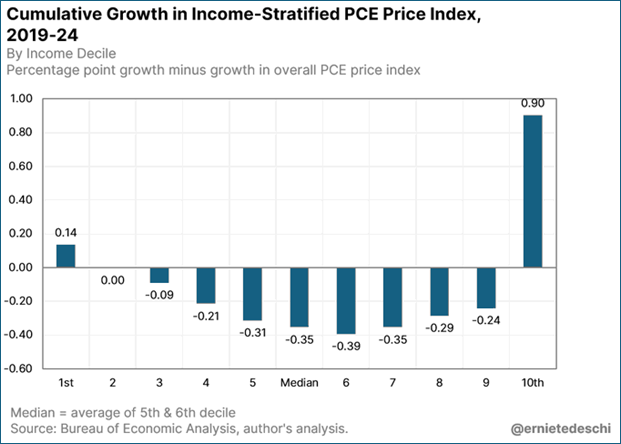
This piece is primarily concerned with how the US capital markets deal with the stresses caused by the combination of increasing public deficits and private infrastructure spending, but I could easily have widened the discussion. We could discuss the way the economic burdens are shared between US households. Working households that do not own a lot of equities and did not lock their mortgages at the lows of 2020 have experienced a significant deterioration in their economic circumstances. It was interesting to look at the BLS CPI data and see the different inflation rates experienced by different income cohorts. Or we could have discussed how the burden is shared internationally, with terms of trade shifts benefiting defence, energy and semiconductor producers. The point being that pretty much all policy has “distributive effects” even if macro-types often obscure them. And that’s true of both fiscal and monetary policy.
So back to who will pick up the tab in US capital markets?
One possible answer is bondholders. Inflation erodes the real value of fixed coupons and principal, enabling borrowers to repay creditors with dollars that are worth less than expected. In the 1970s, unexpected inflation may have imposed cumulative losses on holders of US federal debt equal to roughly 6–7 per cent of one year’s GDP, although bond investors got all that back and more in the 1980s. Prior to Warsh’s recent relative hawkishness, long-end yields had been selling off, pressured by higher headline inflation associated with higher energy prices. Bondholders don’t want to hold assets which decline in value. So, one could think of Warsh’s hawkishness as a promise that this will not happen again. The Fed’s recent hawkishness also alleviated the pressure on the dollar, and one might argue that makes sense in the same frame: higher levels of uncompensated dollar inflation are a great reason to own fewer dollars. Whatever the other demands on America’s resources, investors in longer US Treasuries will not be required to finance them through an inflation tax. While the Fed did not raise rates, it adopted a markedly tougher stance on inflation. It also reduced the extent of its forward guidance, which had the effect of increasing uncertainty about the future path of policy.
Sceptics might ask how this helps Warsh make progress in his broader objectives? Well, one possibility is that it’s embarrassing to be seen reversing course. Of course, central bankers change their mind all the time, and that’s an entirely sensible thing to do, but no one enjoys being proved wrong quickly, and it certainly doesn’t add to the prestige of a central banker. Central banker prestige can be thought of as a type of magic pixie dust. It allows central bankers to say “transient” or “trust me bro” without being laughed at. At least for a while.
Warsh tells us that he has other perfectly good reasons. If markets are to be useful predictors of policy rates, they should focus directly on macro and not the Fed’s reaction function. This is precisely what I would expect a good economist to argue. Not because it is true (it might be) but because an economist’s job is always to justify his master’s preferred policy. I’m far too cynical to believe that rationalisation, even though it’s perfectly reasonable. It’s possible, and indeed some might plausibly say that the Fed and markets have become trapped in a self-referential feedback loop, where the Fed looks at market pricing to infer economic and financial conditions, and the market then prices assets based on Fed statements based on current pricing. Still, even if the argument has merit, it clearly benefits Warsh and the WH to maintain maximum policy flexibility and being the cynical sort, I struggle to believe that the primary rationale is more efficient price discovery.
Regardless of his motives, Warsh’s renewed hawkishness did ease the pressure on the long end, at least for a while. And he did so with talk, which is always much cheaper than action. The test of Warsh’s hawkishness will come when defending price stability actually costs something: perhaps weaker growth, falling asset prices or higher unemployment. And we might be getting quite close to that test today.
FOMC meeting: tactics vs strategy
I can’t help you very much with the meeting. I do think there is a solid chance Warsh will take the opportunity to hike rates, but I think that’s already priced. That’s because there are all sorts of tactical advantages to doing so, even if you agree with me that there is little to no longer-term threat from inflation. I happen to think that it’s inevitable that we will experience another short-term bump in inflation, but I also doubt that it will cause any further “de-anchoring” of inflation expectations or “second round effects”. If Warsh’s FOMC hikes, it will be at least partially from tactical considerations: a chance to burnish his hawkish credentials and demonstrate both his independence from the WH and his collegiality with his FOMC colleagues. Doing so now means Warsh can point to the proximity of November at the next meeting, giving him more time to assess conditions.
As I said above, the inflation justification is certainly not beyond dispute. Energy and supply-chain shocks can generate nonlinear price effects, and Warsh and Co may feel compelled to demonstrate their “credibility” before expectations become unanchored. But current market and business inflation expectations really do not point to an imminent inflation spiral. Labour markets do not exhibit pricing power: if they did, real wages would be going up rather than down. Framed in burden-sharing language, a hike blesses the decline in real wages and leans policy towards more of it. Wages and consumption should come down to create the space for datacenters to be built without even more inflation.
But there is also an important question about instruments. Sometimes Central bankers have to think about the longer game, and this might be one of those moments for Warsh. Warsh has previously argued that the Fed should rely less on the policy rate and reduce the size or duration of its balance sheet. And it’s a sensible longer-term objective. Do you really want the Fed to be in the business of allocating capital? Instead of raising short rates, the central bank could allow more long-term Treasury risk to return to private markets, which would probably require higher risk premiums at the long end. I doubt Warsh will focus his attention on the balance sheet at this point, but I can see how a tactical increase in policy rates now could set the scene for further reductions in the balance sheet going forward, allowing Warsh to subsequently trade lower policy rates for removing balance sheet accommodation at the long end.
That might look like a less damaging form of tightening, but really it simply changes where the pressure appears, or rather, who bears the burden. More of the pressure is brought to bear at the long end of the curve rather than the short end. Corporates borrow at the long end, and there might be some natural justice in that, given it is corporates, and particularly hyperscalers, who are driving the demand for datacenters. There is a sense in which raising the borrowing costs associated with building datacenters is more “efficient” because that is one of the proximate causes of the current uptick in inflation.
Higher long rates don’t only affect hyperscaler borrowing costs. They also impact new mortgage borrowers. Using monetary policy to control inflation has already resulted in an important burden-sharing effect. Older generations who had locked in low rates have much lower housing costs than first-time buyers. And there are important distributional effects in markets. When the Fed holds fewer government securities, private investors must hold more. Banks, money funds, insurers, pensions, hedge funds and households must devote additional capital and balance-sheet capacity to financing the government.
Treasuries then compete more directly with private borrowers. The federal government will still be funded and so will the largest and most profitable technology companies. The leading AI-adjacent businesses possess cash flow, collateral and direct access to capital markets. The vulnerable borrower is small business: the low-profitability business, the highly leveraged borrower, the small company dependent on bank credit, the commercial-property owner facing refinancing, or the speculative firm whose business model required cheap money. The analogy I prefer is kids playing musical chairs. When one chair is removed, usually there is a chair for most of the nimble kids. Sadly, sometimes it’s the slightly overweight kid with slow reactions that’s out of luck when a chair gets removed. These borrowers cannot compel markets to fund them. As Treasury supply absorbs more private capital and high policy rates raise the return available on safe assets, lenders become more selective. Spreads will widen (further), covenants tighten, and marginal borrowers lose access altogether. Protecting the government bond market will place additional stress on the rest of the capital markets. But
This is the burden-sharing implication of moving intermediation from the Fed’s balance sheet to private balance sheets. The central bank reduces its own footprint, but private institutions must decide which claims deserve the scarce capital that remains. They are likely to prefer Treasuries and highly profitable businesses, like the AI incumbents, over weaker private borrowers. But there is another important allocative implication: we use long rates to discount long-term cashflows. Tech companies are generally considered growth stocks, and growth stocks are much more sensitive to long-term discount factors. Whatever the discounted value of long-dated cashflows, they will be worth much less when long rates are higher, and discount factors are lower. Long-dated cashflows have counterintuitively high durations, which explains why I have lost so much money on the 30-year TIPs I bought at the seemingly cheap 2.75%. They now trade at 3%. It’s probably a great investment, but it’s definitely been a crappy trade.
Higher short rates could have a perverse allocative effect. I doubt higher rates will do much to slow the AI buildout because its largest sponsors can finance investment internally. Instead, tightening will suppress housing, small businesses, conventional investment and labour demand, thereby releasing resources for AI. So, one might view Warsh’s approach as deciding which sectors must retreat to make room for the AI buildout.
Nor is it certain that higher rates work as they conventionally do in a heavily indebted economy. Higher rates will act to increase government interest expenditure and increase income received by holders of interest-bearing assets. The winners from higher rates are unlikely to consume their winnings. They will put that cash back into markets, which, if you were trying to increase US savings rates, would actually be beneficial! At high levels of debt, the economy may behave less like the familiar Taylor-rule model and more like a system in which higher rates themselves sustain nominal income and fiscal expansion. I think of this as Warren Mosler’s observation, but if you went back a bit further you might think of it as Irving Fisher’s. And maybe we are now in a Fisherian world, where the Fed can’t really influence the level of real interest rates. Those are now being bid up globally. All the Fed can do is set the nominal rate.
Bottom line
Let’s say the FOMC does hike rates (probably fairly priced at a 35% shot). I suspect the long end will rally, and reasonable observers will frame the rally as driven by a perceived “policy mistake” or potentially as reversing the previous policy mistake. But you could equally describe it as a conscious decision to protect long rates at the expense of the short end and all the borrowers who have no choice but to borrow at the short end. Value stocks, small businesses, midcaps, multifamily owners financed at the 5-year point, or Business Development Corporations and leveraged balance sheets in general will be the losers. Growth stocks and longer duration bonds will be the winners.
It’s ironic really. Even if Warsh decides to start the process of getting the Fed away from picking winners and losers in capital markets, that inevitably involves picking new winners and losers. And that’s because, as much as we macro types try and obscure it, policy always involves winners and losers.
Harry, great discussion, thanks. personally, I am thrilled that we are seeing uncertainty in this outcome as uncertainty reduces leverage and that is a major problem hanging over markets I believe.
As I think about what you wrote and the idea that economics is all about tradeoffs and allocating scarce resources, that is definitionally correct. I guess I wonder why that is part of the monetary policy discussion, which should, by rights, be all about money, and perhaps the quantity thereof. it worked for Volcker, right?
I remain a fan of the end of forward guidance as I want to see less certainty and less fragility that comes along with it. the Minsky moment seems much further away under those circumstances than under the previous regime.
it will be interesting to see how it evolves.